New and (un)Improved
Time marches ever on, and as that Bob Dylan song says, the times they are a-changing. Things come and go with the times, and these changes are what can be generally regarded as “progress.” The thing about progress is that it’s not always positive. Take Skittles for example. For some reason they got rid of Lime Skittles in America and replaced them with Green Apple. That was a travesty. Thankfully Lime Skittles were brought back, but at the time they were gone it was not as good. In a more serious and objective example, the time in America immediately prior to 9/11/2001 was better than the time immediately following 9/11/2001 for a distinctive reason. While I’d love to pontificate about the cruelty of time and the poignancy of fleeting moments, what this blog post is really about is my subjective thoughts on progress done wrong specifically in the context of entertainment.
I’ll mainly be ranting about four examples of this; there are several more examples I won’t really touch on but very much exemplify the degradation of iterations of old entertainment; unmentioned examples include Star Wars, every live action Disney remake (excluding Cinderella (and arguably Beauty and the Beast)), the 2018 movie A Wrinkle in Time, the 2020 movie Artemis Fowl, and, the sequel to Enchanted, the 2022 movie Disenchanted.
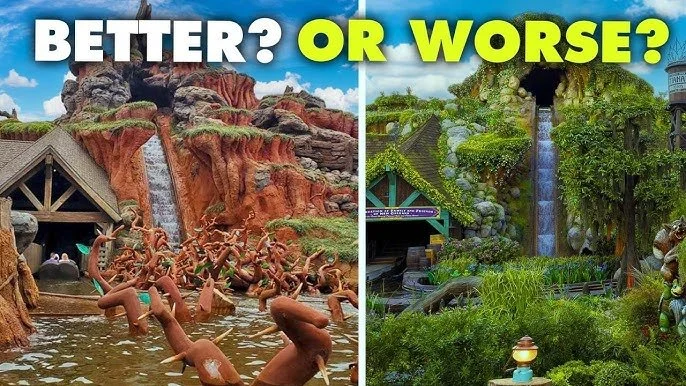
In a little place called Disneyland (Anaheim, CA), there was a little ride called Splash Mountain. It was my favorite ride. Following May 2023, what was Splash Mountain closed, changed, and reopened as Tiana’s Bayou boogaloo-thingamajig. Can you, dear reader, guess what I think of this new ride? It’s worse. To be fair, the ride itself is exactly the same (i.e., the log you ride in, the waterways and waterfalls you follow). The story, soundtrack, and scenery the ride takes you through, however, are different. Instead of numerous neat and entertaining animatronic animals with an interesting throughline, there are now limited and basic animatronics (some replaced by literal cartoons projected on a wall) and a confusing/uninteresting plot about attending a party. Instead of catchy and memorable tunes, there are forgettable and uninspired songs. I was genuinely surprised that the ride did not make use of Dr. Facilier (the antagonist of The Princess and the Frog), him being among the more interesting characters arguably across most Disney movies (and with the best song in the whole movie). The ride lacks conflict and trepidation that was previously there in the way of Br’er Rabbit being caught and cooked by Br’er Fox. There isn’t a teaspoon of conflict in the ride now. So, in sum, overall the ride is worse now.
Contentious topic time: who likes Harry Potter? I do, except for The Cursed Child and the Fantastic Beasts movies. Well, there’s also a new Harry Potter TV series planned for HBO, and I’m… warily intrigued. The Harry Potter movies, as lovely as they are, do skip some significant plot details that a show format could include (for better or worse). While it’s not out yet, and while a lot is speculation, there are things I’d rationalize as justifying a remake in show format (despite my general stance on extending media beyond its origins); the primary thing I’d love to see is the Quidditch World Cup in The Goblet of Fire. That said, there are already some questionable choices in its production. Okay, as far as I know there has really only been one and it’s the casting of Snape. Before cries of “racism” are unleashed, hear me out. The casting choice of Paapa Essiedu to play Snape is, in my opinion, a bad one and not just because of superficial book accuracy where the character is a pasty long-nosed white guy. Getting that superficial criticism out of the way, yes, I do think a handsome black guy playing such a character is ill-fitting. Beyond the superficial characteristics, there are inherent changes to relationship dynamics such a change would make—namely racial biases. If Snape is black, that introduces a whole new lens to look at his history of bullying and abuse in childhood as well as his ongoing antagonism throughout the events of the story. That, to me, is a significant enough change where I would be taken out of the immersion (whether or not the show decided to include or ignore racial politics—which has a track record of going really well). Of course, it’s not exactly a deal-breaker for me, and is more so a disappointing choice if the show is truly aiming to be something as good as if not better than the movies. Speaking of the idea of creating something truly good, I’ve heard it said that a minority was cast for Snape due to Alan Rickman’s legacy being untouchable and casting a similar-looking actor would draw too many comparisons. This sounds credible, but the implications of that mean the production team are assuming they cannot make a Harry Potter series as the best version it can be, they are intentionally avoiding a white actor (i.e., casting with racial bias), AND they are filling a role with a minority actor solely because they expect no one to be able to portray the role as well as Alan Rickman. Talk about the bigotry of low expectations.
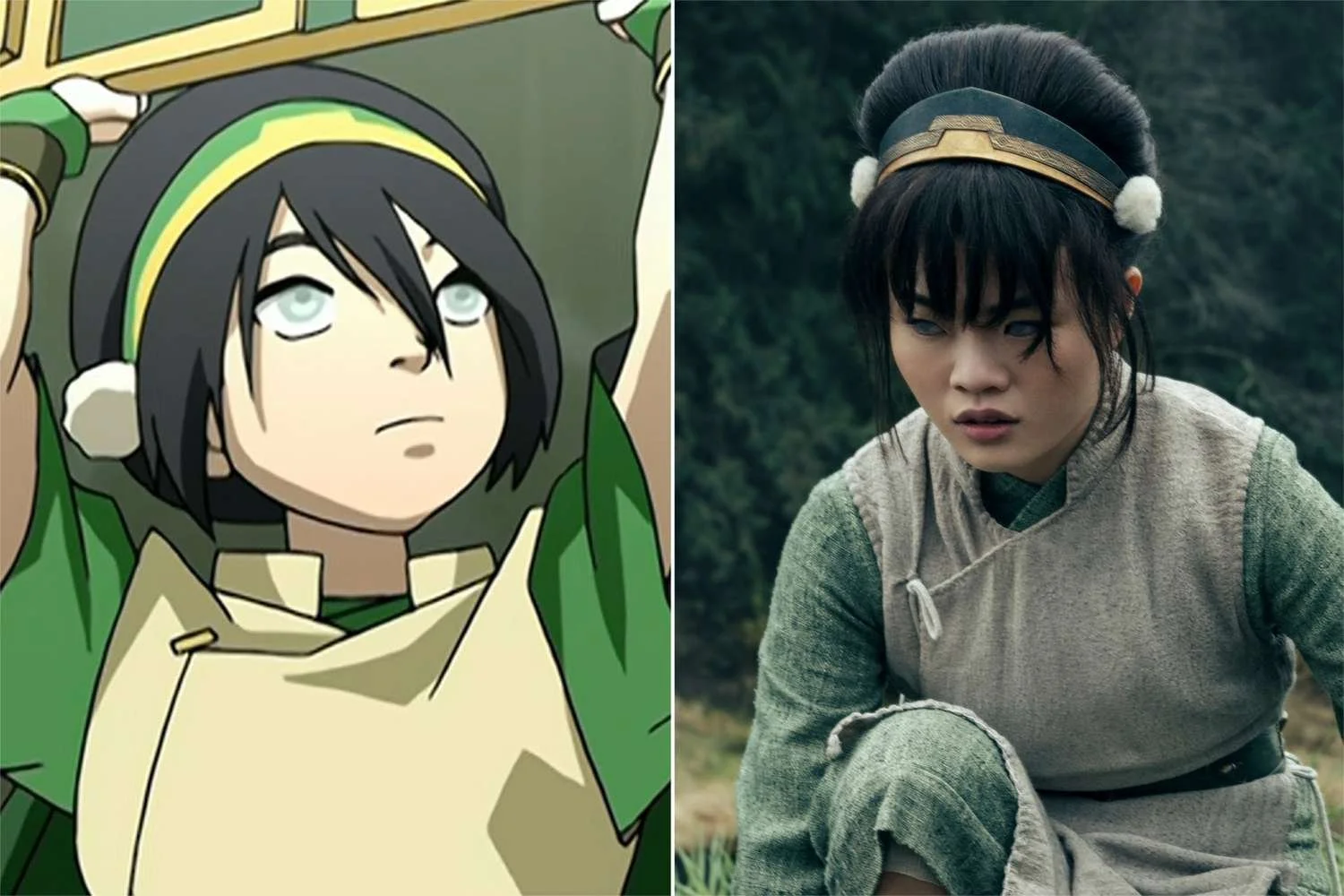
Another remake show currently in the works is the second season of the live-action Avatar: The Last Airbender series. The first season that was released on Netflix in 2024 was bad as an adaptation in my opinion, but if I were to take it as something original (pretending the original animated series never happened) I’d consider it to be okay. I don’t know why this show in particular is being remade as it’s totally unneeded, but money is money, I guess. To summarize my main criticisms of this show, characters are just all around debased, particularly Azula and Bumi. As for the second season, which, again, speculations abound, there is of course other troubling news for a particular character—Toph. Her actor, Miya Cech, alleged the character would be “more feminine” than in the original series… In case you didn’t know Toph’s character, she’s a tomboy. So, yeah, altering her character out of that tomboyishness is… certainly a choice. Okay, I’ll say it, it’s a dumb choice. Completely. It’s infuriating, because just when you have this well-written, unconventional badass female character all ripe for the picking, you choose to feminize her. I just don’t get it—especially considering modern feminism scorns any portrayal of women that aren’t girl bosses who symbolize an unhealthy resentment of men. Like, I expected them to debase her character like they did the others, but in a way that leans way too far into her strong, independent female-ness rather than going the opposite way. Weird. Weird. It’s Hollywood, baby.
What kind of rant about classic entertainment would this be if I didn’t bring up one of the actual classics? Homer’s The Odyssey is due to be adapted into a movie made by Christopher Nolan and… Well, practically every piece of news about the movie has made me more and more skeptical. To be fair, much of my rant involves speculation given the Harry Potter and Avatar shows have not released yet. And yet, director comments and rumors pose some degree of credibility for my skepticism. To get the most contentious topic over and done with, Lupita Nyong’o has been cast in two separate roles—Helen of Troy and her own sister. This follows the same contention as the Snape casting for Harry Potter but with at least one different reason: Paapa Essiedu doesn’t fit Snape because he’s handsome, Lupita Nyong’o doesn’t fit Helen because she’s not beautiful. Beauty, of course, is in the eye of the beholder, but when talking about a character who is “the most beautiful woman in the world” I expect someone who is undoubtedly, near-universally considered attractive. Setting that aside, I personally think having her play her sister is stupid because having an identical sister directly contradicts the idea Helen is “the most beautiful woman in the world.” There’s also the contention of race-swapping the characters, but I don’t really care much about that part as there are more casting contentions surrounding this movie; Travis Scott, a rap musician, has been cast as a bard and Christopher Nolan said “I cast him because I wanted to nod towards the idea that this story has been handed down as oral poetry, which is analogous to rap.” This doesn’t confirm whether there will be rap in this adaptation, but… Look, I’m wary, and I have plenty of reason to be when considering modern versions of previous stories (just look at Andy Serkis’s Animal Farm). The trailer for the movie brought about more skepticism due to it appearing visually washed out and dialogue sounding out of place (e.g., Tom Holland’s character saying, “My dad is coming home,” Matt Damon’s character saying, “Let’s go!”). And most alarming (to me at least) is Christopher Nolan telling the movie’s composer to not use an orchestra. I mean… What? That just removes the possibility of having an epic soundtrack to go along with this epic! WHAT!?
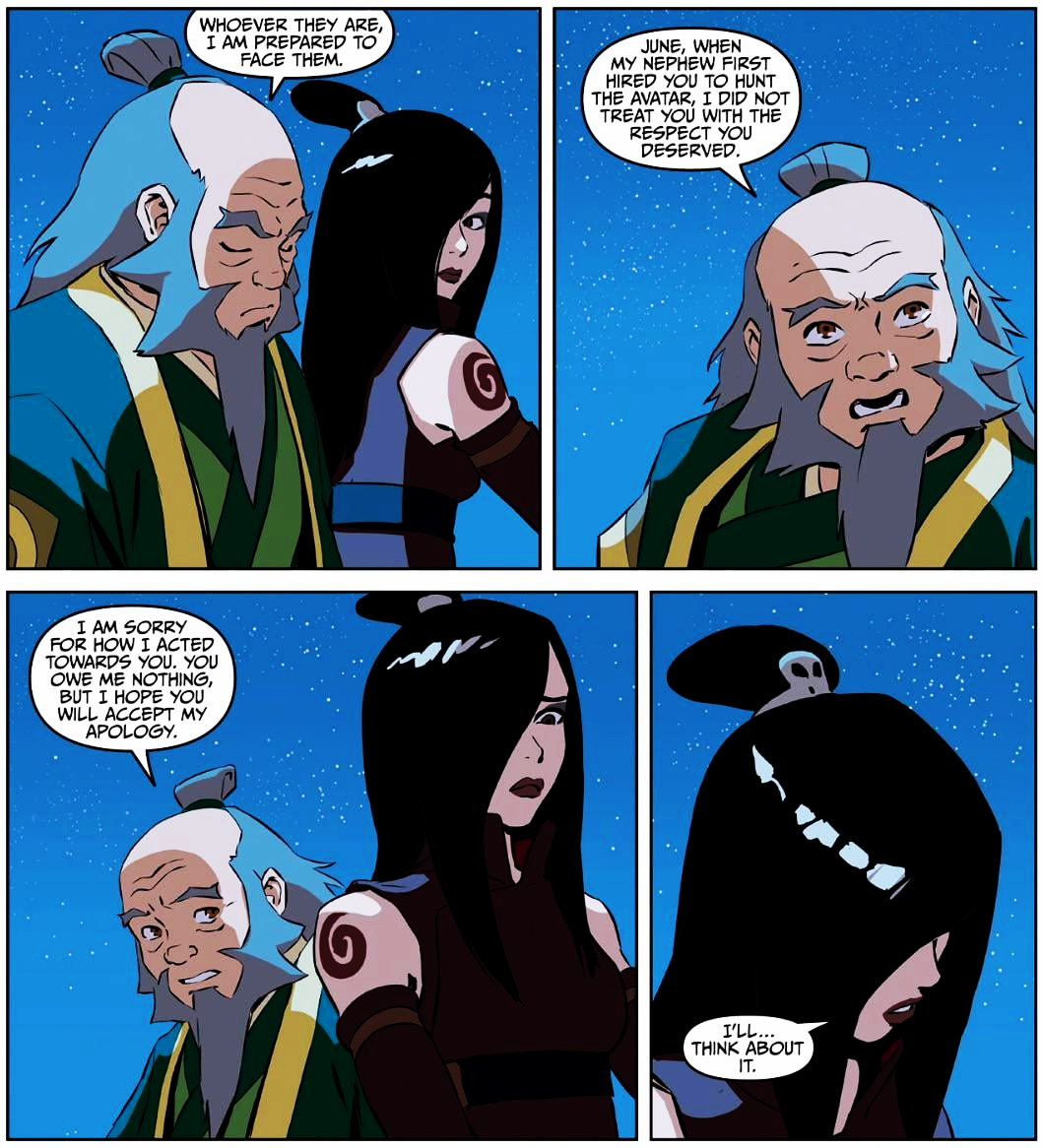
I’ll cap this rant on “improving” older pieces of entertainment with my own speculation of why there is a need to improve such things. No, I’m not going to say money, because that wouldn’t be speculation and rather just plain true. I’m going to say it’s the other things that are among the biggest motivators for people: fame and power. In most (if not all) of my given examples of new entertainment, there is a commonality I noticed: each new thing, explicitly or implicitly, holds its respective older thing in low regard. Updating the Disneyland ride Splash Mountain was inevitable with the changing times, but no small part of the reason for its “improvement” (I’d bet) was to reduce the ride’s “problematic” connection to the film Song of the South. Creating the new material for Avatar: The Last Airbender was inevitable (MONEY), but no small part of the reason for its updates was to “correct” the “problematic” elements of the original show. For example, take this comic continuation of ATLA in which Iroh apologizes for a gag in which a bounty hunter happens to fall on him and he pretends he’s unconscious. (My tangential writing critiques of this is that it’s forced, it mistakenly takes a gag seriously, and it alters June’s character to be meek).
What does referencing these examples of new entertainment criticizing its old counterparts have to do with fame and power? Displaying “correct” opinions in a public format (i.e., entertainment) is a highly popular practice. Just check out any social media post by a celebrity that shares the gobsmacking opinion that racism is bad—you’d be hard-pressed to find one without thousands of likes. This surface-level appeal is why new entertainment—I’d argue—trends towards what’s popular over actual quality (e.g., messaging over story). There’s also the fact that simply working on hot IPs like ATLA and Harry Potter garner a considerable bit of fame. This same fact—working on a hot IP to create something new—is where power comes in. Being able to work on a new piece of entertainment is inherently holding power; that power can be exercised in ways that often gratify the wielder of said power; thus, the people with the power to create new entertainment tend to exercise their power in such a way that emphasizes their own power over old entertainment. They want to be seen as the definitive creators with the definitive version of that entertainment or IP. In other words, their thoughts, reductively, are I will be better—this will better. I wouldn’t necessarily say they experience a high when given such power, but I would say their reasons and conduct reflect what Dr. Ian Malcolm meant when he said, “Your scientists were so preoccupied with whether or not they could, they didn’t stop to think if they should,” and what Gandalf meant when he said, “He that breaks a thing to find out what it is has left the path of wisdom.”