Millennial Writing
Chances are, if you’re reading this, you probably already know to what “millennial writing” is referring. For the sake of clarity I’ll describe it. “Millennial writing” is a term which means writing (i.e., storytelling) that is aimed at millennials (i.e., those born in the 1980s and ‘90s). “Aimed at” is a phrase which means preferred by, catering to, and/or idiosyncratic of millennials. This includes political beliefs (e.g., progressive, postmodern), senses of humor (e.g., irreverent, ironic), and attitudes (e.g., skeptical, pessimistic). Such writing may be written by someone who isn’t a millennial, and such writing may be written for someone who isn’t a millennial—it still is recognizable as inherently involving the aforementioned qualities that can be considered to embody the zeitgeist around the turn of the 21st century.
A less technical and colloquial way to describe millennial writing is simply as being bad. Another way, a term the kids these days use to describe things, is calling it slop. Both work, but I’d like to remain relatively descriptive while picking apart the characteristics of millennial writing. Specifically, I want to expand on why such writing is bad or slop and—more importantly—how it can improve. That’s right, I’m going to be giving my own bona fide writing advice!

Let’s look at one of the most obvious features of millennial writing and what makes it bad: politics. You can reliably identify millennial writing when it features an explicit political message. This is understandably bad because it in essence subjects the audience to a lecture rather than a story. The story ends up being secondary to The Message™. Here’s a hypothetical twist of The Emperor’s New Clothes: instead of the story conveying the dangers of ignoring the truth, instead of the child simply calling out “But he hasn’t got any clothes on!” imagine a young female with pink-dyed hair and a septum piercing shouting at the crowd “The emperor is deceiving you all! Men in power often do! Can’t you see? He isn’t wearing any clothes at all, but he has every one of you silent! You’re afraid, afraid of what might happen if you speak out! That’s hegemony! That’s the patriarchy!” As you can see, The Message™ is painfully obvious and additionally shoehorns a niche belief particular to a political stance (i.e., feminism). Here’s a non-hypothetical example (from the same political frame of feminism) as spoken by America Ferrera in the 2023 movie Barbie:
“It is literally impossible to be a woman. You are so beautiful, and so smart, and it kills me that you don't think you're good enough. Like, we have to always be extraordinary, but somehow we're always doing it wrong. You have to be thin, but not too thin. And you can never say you want to be thin. You have to say you want to be healthy, but also you have to be thin. You have to have money, but you can't ask for money because that's crass. You have to be a boss, but you can't be mean. You have to lead, but you can't squash other people's ideas. You're supposed to love being a mother, but don't talk about your kids all the damn time. You have to be a career woman but also always be looking out for other people. You have to answer for men's bad behavior, which is insane, but if you point that out, you're accused of complaining. You're supposed to stay pretty for men, but not so pretty that you tempt them too much or that you threaten other women because you're supposed to be a part of the sisterhood. But always stand out and always be grateful. But never forget that the system is rigged. So find a way to acknowledge that but also always be grateful. You have to never get old, never be rude, never show off, never be selfish, never fall down, never fail, never show fear, never get out of line. It's too hard! It's too contradictory and nobody gives you a medal or says thank you! And it turns out in fact that not only are you doing everything wrong, but also everything is your fault. I'm just so tired of watching myself and every single other woman tie herself into knots so that people will like us. And if all of that is also true for a doll just representing women, then I don't even know.”
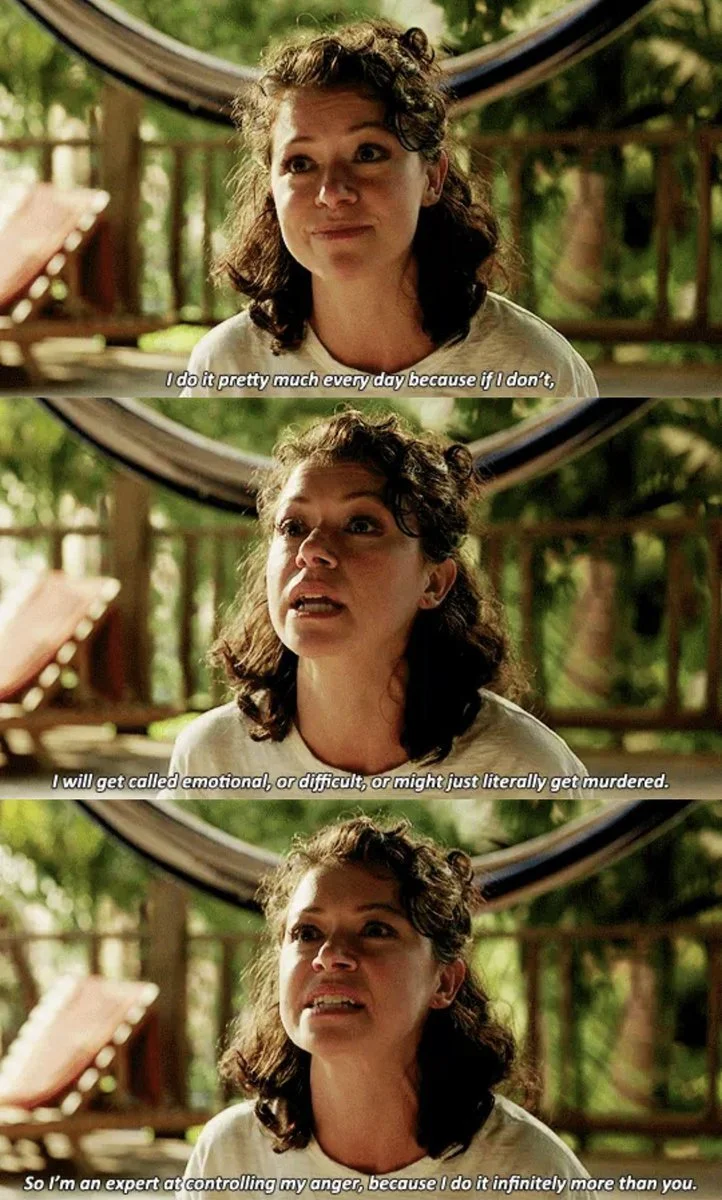
To nip objections with this example in the bud, you can like The Message™ and you can agree with The Message™. That doesn’t stop it from being badly written—it quite literally is given via a lecture. It’s heavy-handed and ironically stereotypical of what (reductively) anti-feminists view feminists as being (i.e., incessant, self-important, martyrish). This lecture was a strange moment, as many of the very subjects America Ferrera mentions are conveyed in a much more effective way throughout the rest of the movie. It also didn’t really fit contextually with the scene, which is another mark against inserting explicit politics into writing—it often is out of place (consider another example in the show She-Hulk in which the main character lectures the Hulk about controlling anger without a blip of self-awareness). Anyway, the bottom line of politics in millennial writing is that it overwhelms the story: the story is secondary to The Message™.
The other obvious feature of millennial writing is its humor. People blame Joss Whedon for shaping people’s proclivity to hardly having a serious moment in a story, yet I disagree since his works like Buffy the Vampire Slayer and Firefly aren’t poorly written in such a way. Sure, people likely borrowed his style of storytelling, but it’s not his fault they failed to use it successfully. Where his humor is paced well (i.e., not pervasive) and consistent with characters (i.e., not uncharacteristic of the characters), millennial writing’s humor is poorly paced and inconsistent with characters. The go-to examples for such badly written humor are in Marvel movies where characters have quip after quip after quip and serious moments are fleeting and diminished. You may notice a similarity in the problem with millennial humor that was true with millennial politics in writing: it is overbearing. I recently had the displeasure of reading over the script for Buffy the Vampire Slayer: New Sunnydale, a show set to reboot the Buffy franchise (that was thankfully dropped by Hulu)—it was expectedly derivative, overladen with references and social commentary, and lacking in characters with depth beyond the quips they spoke. I’ll emphasize what I said earlier: writers try to emulate Joss Whedon’s style and fail. I’ll also reiterate the bottom line: when the humor takes over the story, the story matters less (i.e., is secondary) and the characters are less real.
Now that that’s out of the way, here are my antidotes to millennial writing. Welcome to Torion’s (anti-millennial) Writing Tips™.
Refrain from Contemporary Lexical Conventions
This sort of goes hand-in-hand with a piece of advice I’ll end off with. There’s a song by Tower of Power called What is Hip? that evokes the idea behind this piece of advice, the obvious message being that what is in style is transient. More than that, I find the lines “Hipness is what it is” and “Sometimes hipness is what it ain’t” fitting as, when applying the ideas to writing, it’s cool to write a story that is what it is (i.e., not an imitation) and it’s cool to write a story that is its own thing (i.e., NOT AN IMITATION). Of course, stories naturally take from culture, especially modern culture. But, as Oscar Wilde said, “Life imitates Art far more than Art imitates Life.” So, as tantalizing as capturing the modern moment in writing is (e.g., have a character say “deadass” or dap up his bestie), it’s typically better to write with the intention that it will be timeless. For example, a character saying “Fanum tax,” after stealing another character’s sandwich likely won’t land as well as “I’m hungry,” in the upcoming years (the term is arguably outdated already).
Refrain from Kitschy & Meta Narratives
Just as it is important to avoid writing with an excess of modern peculiarities, it is important to avoid writing with an excess of past peculiarities. Sentimentality as a narrative pastiche rather than a theme is rough to read, as is a narrative with unrefined showiness. I’m looking at you, reboots, remakes, etc. Capitalizing on nostalgia and dressing it up with whatever is attention-getting is certainly a fine business tactic (cough Disney cough), but it makes for poor writing. Self-referential narratives are also eye-roll-y, and nothing makes me want to drop a book or show more than when characters, ostentatious or otherwise, are overly self-aware (to say nothing of breaking immersion). Deadpool being Deadpool is one thing, Star Wars characters saying “They fly now?” is another.
Use Humor Sparingly if at all—the Only Irony Allowed is Dramatic Irony
The obvious exception is if you’re writing a comedy. This advice is for the sake of tone and pacing. It is, again, rough to read/watch a story be debased by out-of-place comedy. The Lord of the Rings is the gold standard when it comes to a story that takes itself seriously and is sincere. Tonal consistency and sincerity are qualities that are gravely lacking in stories nowadays. It’s like writers transferred their psychological defenses in using humor and sarcasm into their writing; I don’t know what else explains the seeming aversion to moments of seriousness. I stuck in an absolutist stance regarding irony because sarcasm as a character trait has become anathema to me and it is too much of an opportunity to violate the previous advice of refraining from kitschy and meta narratives.
Layer Prose with Subtext
Earlier I referred to the writing for Buffy: New Sunnydale as involving characters lacking depth beyond what they say; this advice is very relevant to that. It is superficially interesting for the audience to experience the goings on of a narrative, and it is that much more interesting for audiences to interpret meaning beyond the surface. When a character says, “Ew. It’s giving patriarchy.” (an actual line of dialogue from the Buffy: New Sunnydale script), what’s said is all there is to what the character thinks—the character is a rabid advocate of social justice. Of course, not every word in every line of prose needs to be layered (kudos if you can manage that), but when the narrative is stuck with superficiality then the story will only ever be appealing on a surface level. I can think of a number of ways the above dialogue could be written without violating every one of these tips, each deepening the character, her relationships, and her role in the story. Anyway, this advice is more or less a quality check.
Write Characters as Themselves, Not as Yourself
This is a growing struggle for many nowadays, beyond writing. While calls for awareness and for empathy and whatnot may give off the impression people are aware of others’ perspectives, it is increasingly common for people to substitute what someone else thinks with what they themselves think. People seem to know what empathy is but people don’t seem to reliably have it. Similarly, they don’t seem to have a functional (accurate) theory of mind. Having a theory of mind is basically being able to understand other individuals as being different from oneself as well as being able to understand their individual thoughts, beliefs, feelings, and intentions. When it comes to writing (millennial writing), it’s often the case a writer’s trait or behavior or belief is inserted into what a character is, does, or believes. That is, a person (the writer) is being centered in the story regardless of who and what the character is (and regardless of what the story is about). This is why empathy and theory of mind are useful, both in general and in writing. A story consisting of different characters is better (i.e., realistic, interesting) than a story consisting of variations of yourself, just as a world of different people is more realistic and interesting than a world of clones.
Don’t Reference—It’s Almost Always Anachronistic
This is pretty self-explanatory, as the reason is given in the advice itself. Realistic or real-world fiction is mostly the guilty party for this advice and why I’m giving it. I get it, it’s fun when you know the reference (i.e., you’re hip). But, a reference tends to take the audience out of the story and break immersion. This remains the case even if the reference is relevant and true to a character. And, as with my first tip, times change and what is hip today might become passé.
As with all writing advice, it’s not always applicable. The tips, advice, rules, whatever—they are all guidelines. So, I think that just about wraps up all I have to say about millennial writing. It’s just been something on my mind, with all these modern stories oozing social commentary and stories being less so stories and more so products of business and political interests.