The Dark Tetrad of Education
A bit ago I made a blog post about consequence avoidance, as in the way students are able to avoid consequences. I mainly mentioned the way schools enabled students to do so, which in turn created cohorts of educated illiterates. Here, I’m going to somewhat expound on the problems I’ve observed with education and the four responsible parties for why education has/is going down the gutter (I must emphasize, this is all anecdotal and my opinion).
Parents
Who’d’ve thunk it, the primary caregivers of a student being responsible for the student’s well-being and upbringing? I don’t mean parents are genotypically responsible (although the biological makeup of a person is quite influential), I mean they are phenotypically responsible—namely with the way their children behave. If students grew up with unstructured screentime, students will behave using electronic devices in an unstructured manner (this typically means their phone use is rampant and difficult to inhibit). In other words, a kid who is on their phone during meals will likely be on their phone during classes. Parents who don’t teach the basics of social conduct and civility are setting their kids up for a slew of difficulties. I went to the obvious example of phones (because phones really are a major obstacle to the capacity to learn in an educational setting (and the capacity to socialize in a social setting)), but there are other things parents should teach yet fail to teach. General skills like eye contact, single-focus attention, individual responsibility and accountability, understanding and respect for rules and authority, problem-solving, patience, etc. Parents should also be monitoring the activity of their students reasonably (e.g., checking homework, grades, teacher reports) and be neither overbearing nor uninvolved. It’s not unusual (in my experience) for a parent to be MIA throughout the school year and then suddenly become responsive at the close of the year and have the gall to be surprised and angry at the school for academic concerns that have been long known and documented. If students lack a working model for how to address challenges, it is undoubtedly an issue derived from deficits in parenting.
Teachers
I went with parents first because they are first and foremost the ones responsible for a student’s upbringing. This upbringing significantly affects how well teachers can focus on their jobs rather than becoming the proxy for parents who failed to be parents. Teachers aren’t parents, nor are they friends, but teachers often fill these roles when these roles are absent from a student’s life (or when a teacher forgets their own role). Responsibility lies with parents for failing to manage their role, but responsibility also lies with teachers for stepping into an inappropriate role and carrying out inappropriate duties. Thanks to my own role as a therapist with much time spent on school sites, I’ve experienced firsthand the deficits teachers display in their teaching. I’ve sat through classes in which students were endlessly disruptive or off-task or late or absent, and the teacher did nothing about it; and I’ve seen students break rules, treat peers and others disrespectfully (see next section for examples), and just behave in irrefutably awful ways, and the teacher did nothing about it. Anything short of a physical altercation was on the table for students to engage in and do—and do they did, because they could without any repercussions. Coupled with piss-poor discipline skills, I’ve seen teachers simply suck at teaching; for students who arrived as late as the last ten minutes of class, the teacher went ahead and marked them present; for students who remained on their phones and refused to do work, the teacher ineffectually requested they put away their phone (which the students of course ignored) before going ahead and marking their assignments with passing grades (this was also true for students who did attempt the assignments but didn’t actually do the assignments correctly); and for students who complained after noticing the unfairness in the academic effort they put in resulting in the same outcomes as students who did little-to-nothing academically, the teacher pathetically shrugged, gave non-answers, and went on as usual. I’ve been genuinely shocked at the sheer obliviousness teachers have with their own conduct that overlooks or ignores poor conduct and poor academics. Of course, when there is nigh always a way to avoid consequences, much can be overlooked and ignored.
Administration
The people who are meant to facilitate and support the learning environment for teachers to do their jobs are very much responsible for the failures in education. When teachers lack the support to enforce a consequence, teachers discover they are helpless and thus don’t bother enforcing consequences. In turn, this teaches students they won’t receive consequences and don’t have to try as hard if at all. I, myself, have been incredibly frustrated with being in a quasi-teaching role and having to enforce discipline for students who significantly misbehaved only to be undermined by an admin. As one example, a student was feigning throwing things at another student, cussing at other students, using slurs, insulting, slandering, and threatening other students and staff, and moving and slamming objects and furniture, and all these behaviors were persisting regardless of my attempts to reduce the behaviors, redirect the student’s attention, and deescalate the student’s mood; the assistant principal escorted the student out of class for little more than a minute before the student returned and proceeded to engage in the same behaviors.
What’s funny (or depressing) is this same student had over 20 incident reports written up over the course of the school year (note: teachers regularly didn’t bother documenting misbehavior so this is a generous estimation of actual misbehavior), caused injury to other students on at least 5 separate occasions, was suspended roughly 10 times, and received 2 manifestation determination meetings in which one determined the student’s behaviors were not a result of disability or the school’s negligence (which was honestly surprising as there’s a tendency in schools to excuse everything by chalking everything up to a disability) yet the school only decided to create a behavior intervention plan (BIP (this ideally is used by educational faculty to manage students exhibiting “difficult” behaviors, but in practice is used to kick the can down the road, ignore the elephant in the room, and reject the idiom “You can lead a horse to water, but you can’t make it drink”)) following the first meeting and then decided to maintain the status quo following the second meeting—that is, even after all of this, the school admin chose to refrain from any meaningful disciplinary actions.
As another example, a majority of students remained on their phones regardless of the number of times I requested they put them away; upon my request for an admin to come by and take phones away, an assistant principal walked in and asked the class about what songs they liked to listen to which invited everyone to bring out their phones and use them for whatever. Thankfully, this role was contracted and only for periods within therapeutic special day classes (TSDC) per students’ individualized education plans (IEPs), but even when outside a teaching role it was aggravating to observe admin fail to enforce phone and other policies, generally sabotage teachers who infrequently (admittedly rarely due to the above reasons teachers fail in their role as well as learned helplessness) appealed to them to enforce something, and have the gall to hold district meetings in which they’d steer conversations about academic performance and conduct within classrooms with buttery affection of how grand and difficult education roles were as well as how “capable” and “smart” so-and-so was without any real intention to follow through on addressing problems. In my myriad of conversations with public school teachers, I learned from one TSDC teacher that they literally cannot give zero credit for anything they grade due to policies admin seem to actually enforce—that is, if a student was absent and did none of the assigned material even when given makeup opportunities, the student still received a 10 out of 20 points for that class; further, if a student was present but did jack all for what was expected in the class, the student still received a passing score because, well, according to admin (and oftentimes teachers), “they still tried.” Suffice to say, no matter how good a teacher is, if the admin is ineffectual with providing discipline and supporting teachers, it’s a serious detriment to whatever education is being provided.
Students
Yes, students are responsible for their own education as well. Students are individuals, and as such are autonomous and have agency. Parents may set them up to behave poorly, teachers may carry them further along that path of degeneracy, and admin may facilitate and exacerbate this process, but students also can defy environmental deficits and behave in an appropriate manner conducive to learning. As with the general skills parents should teach, students should be aware of and capable of them; eye contact, single-focus attention, individual responsibility and accountability, understanding and respect for rules and authority, problem-solving, patience, etc., students are responsible for what they do and can do. When a student acts out, ditches class, puts earbuds in and goes on their phone, takes one look at an assignment and gives up, makes crass remarks, disrespects others, whatever, it’s not someone else that’s pulling their strings, it’s the student. On the opposite end, students could have an environment where everything is good or right, and the student could still display deficits. As the aforementioned saying goes, you can lead a horse to water, but you can’t make it drink.
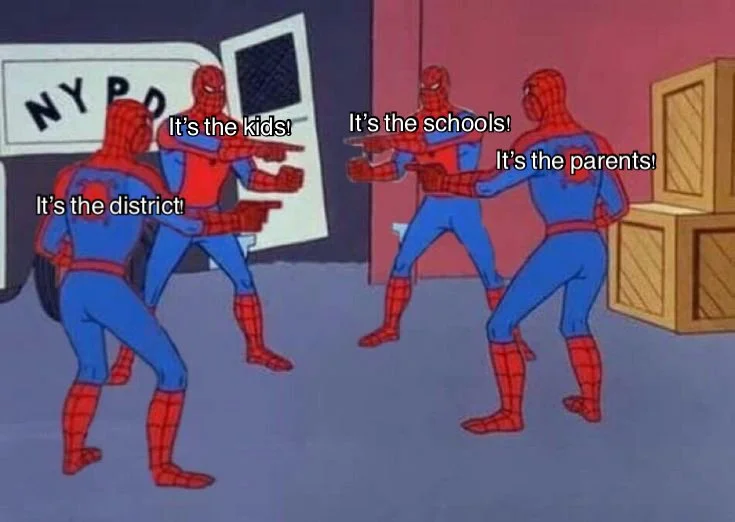
You probably noticed the title which refers to these four responsible parties. What makes this tetrad dark is when any or all four fail to adequately meet a threshold for which education can functionally be provided. It very much is a problem that all four being dysfunctional (i.e., dark) in concert is real and really happens and (arguably) happens consistently. Personally, I think it’s futile to debate which party is more responsible, which oftentimes is what debates of education revolve around. Ideally, each party should be addressed to correct whatever needs correcting. It takes a village, as they say.
Tangential point: this overall problem with American education feeds into another problem of disciplinary issues being addressed as mental health issues. While there’s overlap, it’s often (I’ve found) mental health supports are used as substitutes for discipline. You can imagine why, then, this matters to me.