Backrooms, Meta, and Acceptance
“The narrative of our minds is ongoing, and as such we can’t clutter them with everything all at once; thus the function of memory exists. Unfortunately, each remembrance is virtually a retelling, and each time we remember, details are added, omitted, or spun in a self-enhancing way.”
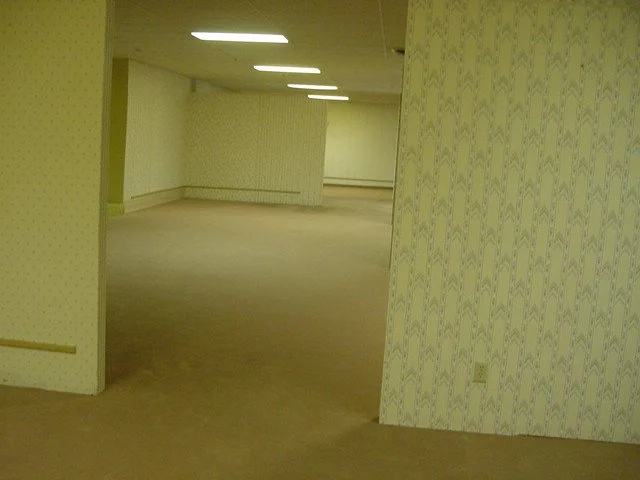
I recently watched the movie Backrooms and I found it very enjoyable and thought-provoking. The Backrooms (i.e., the concept rather than the movie) has been an internet fascination for some time that originated from a photo taken in the early 2000s and became popularized when a 4chan user added a caption to accompany the photo in 2019. I am not at all versed in the lore of The Backrooms, and really the extent of my knowledge of it comes from that iconic picture and caption. The concept, in sum, is that there is a “place” that can basically be considered an alternate dimension. In it are seemingly infinite areas where things are like reality but are off in some way; these areas and things can be considered iterations or copies. There are plenty of interpretations of the 4chan post, which in its own ironic way mirrors the concept. Unlike the iterations within The Backrooms, however, I won’t say people’s interpretations are inaccurate or inexact. They’re simply their own takes on The Backrooms, which is fine for them.
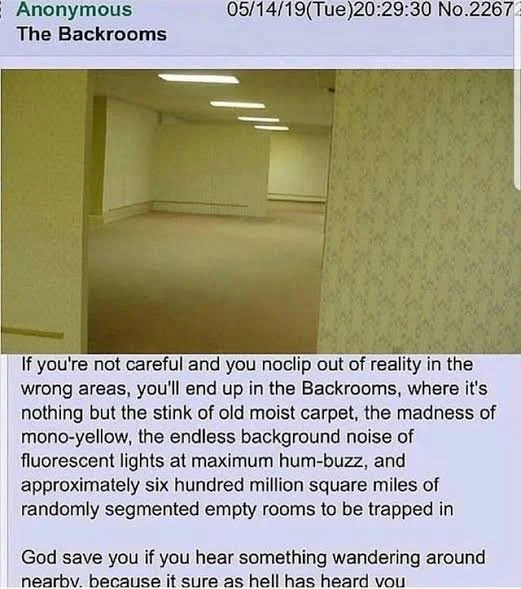
Leading up to the release of Backrooms I noticed much speculation and skepticism of how the movie would do. Many anticipated an “unfaithful” take on The Backrooms while many others anticipated a “faithful” take. I, myself, had my own opinions of what would make the concept as told in a movie format better or worse. Looking back, I recognized several of my and others’ opinions as being wrong. One of my wrong opinions was that if there was a reliable way to go in and out of The Backrooms it would diminish the tension—the movie does a great job maintaining tension even with such a way in and out; a wrong opinion others had was that if there was an actual “monster,” especially one that was clearly shown, it would diminish the tension—the movie does a great job maintaining tension even with an explicit “monster”. I’m referencing all this about what people thought and think the story of Backrooms (and the wider concept of The Backrooms) to be about not just to demonstrate ironic parallels and allude to the movie’s meta commentary with my own commentary but to also emphasize the necessity of acceptance.
Hold onto that idea of acceptance while I finally give my review of Backrooms (warning: my thoughts and the blog post hereafter will contain SPOILERS):
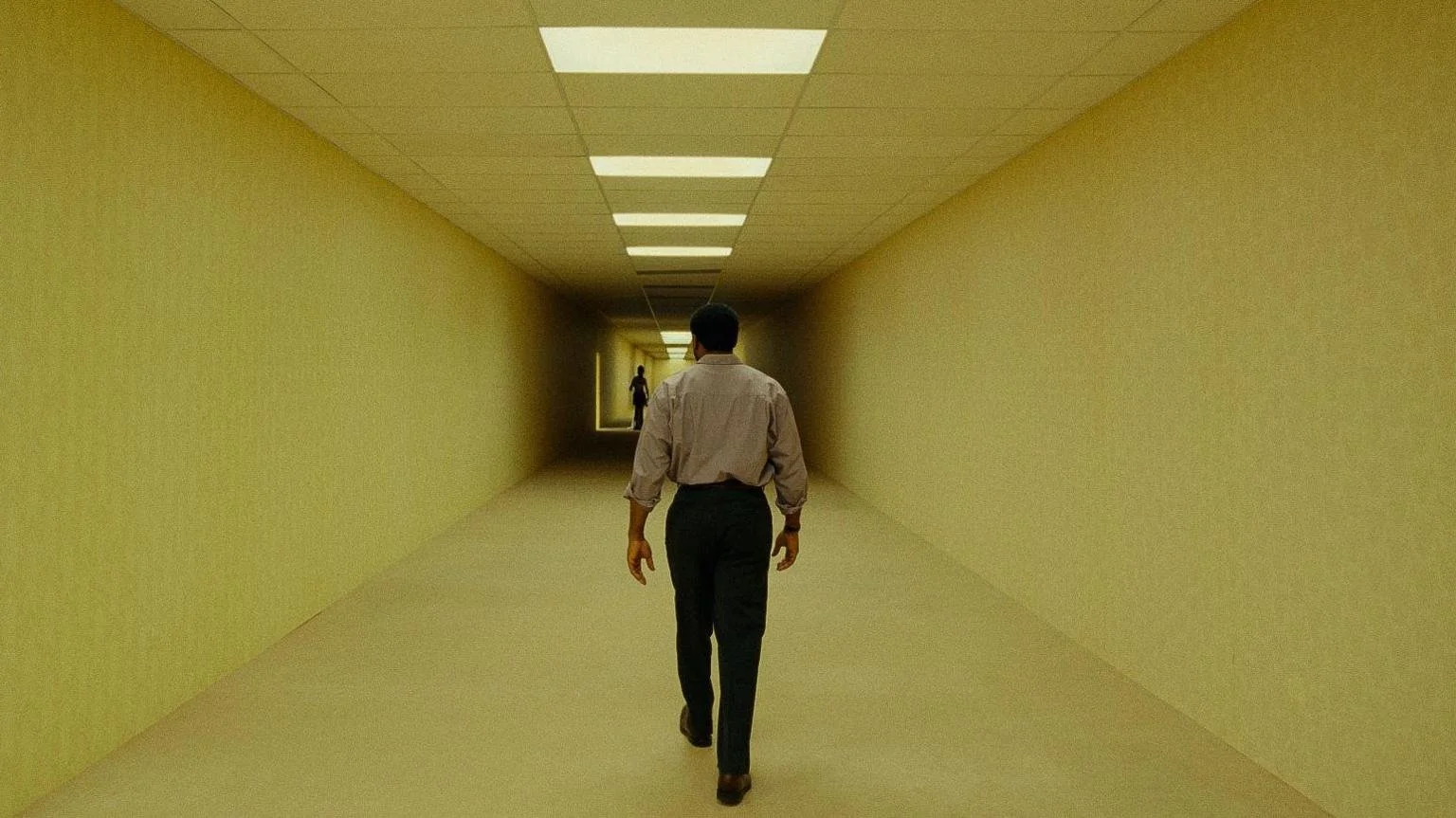
The movie is the kind of horror I like: not overtly scary, not gore-filled, but persistent, prolonged discomfort. There are certainly scenes with overt scares, but they are few (arguably only two (and arguably none are jump-scares)) that serve as the payoff to extended periods of unreleased tension. Chiwetel Ejiofor (i.e., Clark), who plays a struggling furniture salesman, and Renate Reinsve (i.e., Dr. Mary Kline), who plays his therapist, do great jobs serving as the leads and point-of-view characters that contend with The Backrooms. I say “contend” rather than explore because, while it is an eerie, labyrinthine place, it very much is also an allegory for a mind. What or whose mind exactly is up to interpretation, but I don’t think it’s a coincidence that the story showcases the two’s therapeutic relationship as well as references both their personal mental health as shaped by their respective histories. Things that are copied there resemble real things outside, but are, again, inexact, like memories. A quote from the movie: “The more times it remembers something, the less it does.” So, I think Backrooms succeeds in presenting The Backrooms on two fronts, both in it being a thoroughly eerie place the characters contend with as well as it being a challenging mental dilemma both characters contend with (i.e., themselves). Perhaps an odd comparison, but in this way it’s a lot like Into the Woods (i.e, the “woods” being an allegory for life in general). Outside the characters and story, the sound design, soundtrack, and cinematography are really good. My main point of criticism is that the pacing can be somewhat slow in parts—for me it was following Clark prior to his discovery of The Backrooms. Another lesser criticism is how the researchers slightly didn’t fit in to the story. Overall, I’d give it a 4 out of 5.
So, review aside, I have more thoughts on the story, audience reactions to it, and its themes (keep hold of that idea of acceptance I mentioned earlier). The story follows Clark who has a therapy session with Mary, during which it’s revealed that Clark has feelings of insecurity (e.g., anger, denial) regarding his status; via therapeutic roleplay he had an argument with his ex-wife (what is likely the breaking point of their relationship) regarding his struggle to be a provider as well as a successful architect. Mary shares a meaningful perspective about loops and being stuck:
“We all have our loops. Our habits. Behaviors that keep us walking in circles... You learned to push people away before they could hurt you. And now, as an adult, you're still stuck right where you started. Alone.”
This quote, you might have guessed, is pretty relevant to what The Backrooms represents, at least for Clark and Mary, as it comes back up in conversation between them, particularly in a repeat of the same roleplay towards the movie’s climax when they’re both in a pseudo-dining room within The Backrooms. To expand and speculate on each character’s mental challenges: Clark displays symptoms of narcissism (e.g., the way he looks down on his wife as alluded to in the roleplay, the superior way he views himself as alluded to in the same roleplay (and as alluded to in the way he refers to the copied people in the backrooms as “furniture”), how he treats his employees more as useful tools rather than people); Mary displays symptoms of trauma (e.g., the way she ruminates about her childhood and the way she was raised as alluded to in visual flashbacks and a keepsake in the way of a piece of a concrete handprint she and her mother made in a walkway to their house, intrusive thoughts about her mother and childhood and dissociation as alluded to in brief scenes of her life outside of therapy); and, though really only a character in memories, Mary’s mother displayed symptoms of hoarding and agoraphobia (I mention her because she very much shapes Mary’s mental health and what The Backrooms represents to Mary in that she was trapped inside). These conditions are interesting, perhaps more so for me as a worker in the field of psychology, but I digress. The quote is relevant to both Clark and Mary, and it is in the climactic pseudo-dinner scene and roleplay that Mary addresses her countertransference and speaks to her mother (i.e., Clark) in a way that finally rebukes her and, most importantly, accepts that she can’t change her while asking to be let go. This serves as a pivotal moment of triumph and tragedy (depending on how you look at it) as Clark becomes fully committed to his desire of not wanting to change (i.e., to remain in The Backrooms) and is subsequently eaten by a copy of himself (you could say he was full of himself) while Mary flees. The success of her escape is debatable, as it somewhat mirrors how she was able to escape her mother in childhood (at least physically), but I prefer to believe she truly did escape and do what Clark refused to do—accept himself and change. The movie’s final sequence that ends showing a copy of Mary sitting alone in The Backrooms, I think, symbolizes that that version of herself, the one that’s stuck, is now itself a memory.
Maybe this is too optimistic of an interpretation, but I find it the most compelling so it is my interpretation. There’s plenty more to interpret about the characters and The Backrooms such as it all representing the rampant hollowness of AI, but I digress again. As for reactions, including those preceding the release of Backrooms, I think a lot of them failed to accept the story that the movie gave. Many probably wanted a more modern type of “horror” in the way of overt scariness, and others probably wanted the opposite in the way of greatly restrained scariness. I’m not saying what people wanted from the movie is wrong, but I do think there comes a point where people need to accept and enjoy the story for what it is rather than deny its quality and insist on their own view of how it “should” have been. They, in turn, can get stuck in a paradoxical loop of experiencing the same thing (e.g., emotional turmoil of anger and disappointment due to the repeated conflict of what they want to be versus what actually is), and may end up consuming the same forms of things they enjoy until it consumes them. Like Clark.
I don’t want this to come across as me seeming supercilious. That last point was really only directed at the kinds of people who don’t in good faith take the story that was given to them for what it is. There are plenty of valid reasons people don’t and won’t like Backrooms like I did. Hopefully, I somewhat explained why I liked Backrooms, as well as demonstrated the relevance of meta and acceptance.
P.S. Some extraneous thoughts about what I liked in Backrooms: the final sequence that on the surface feels like a classic “unresolved” kind of ending does well in resurfacing the tension that was built in earlier sequences in the movie (and it’s fun that that tension remains unreleased thanks to that ending shot); and subtle and unexplained things within The Backrooms added to the eeriness of the place (e.g., a shot shows a hand protruding from a dark and obscured spot).